Under its mission to "contribute to the advancement of society by creating value in the construction industry through continuous innovation," HanmiGlobal incorporates its responsibilities not only to customers, employees, and shareholders, but also to society as a whole into its business operations. As a global company, HanmiGlobal regards the protection of human rights and the prevention of human rights violations throughout its business operations and value chain as fundamental principles of its human rights management approach.
To this end, the company supports internationally recognized human rights and labor standards, including the UN Global Compact's Human Rights and Labour Principles, the UN Guiding Principles on Business and Human Rights (UNGPs), and the ILO Core Conventions, while complying with the labor laws and regulations of every country and region in which it operates.
Approved by the Chief Executive Officer, HanmiGlobal's Human Rights Policy applies to all domestic and overseas subsidiaries, affiliates, joint ventures, and employees. Where differences exist between the company's policy and local laws, the more stringent standard is applied.
HanmiGlobal's Human Rights Policy establishes the principles for protecting the fundamental rights of its employees and stakeholders.
The policy covers the provision of a safe, healthy, and comfortable working environment; respect for diversity and the prohibition of discrimination; humane treatment; the prohibition of forced labor and child labor; fair treatment and support for education and training; compliance with and continuous improvement of working conditions; the prevention of workplace sexual harassment and bullying; the prevention of corruption and bribery; environmental protection and the fulfillment of social responsibilities; the protection of the human rights of local communities and vulnerable groups; and the protection of customers' human rights.
Based on this policy, HanmiGlobal manages employees' working conditions and ensures fair treatment while also considering the human rights of stakeholders who are directly or indirectly affected by its business activities, including suppliers, customers, and local communities.
The company also seeks to strengthen human rights protection by continuously monitoring and addressing human rights and labor-related risks, applying a zero-tolerance approach to violations, and promoting greater awareness and understanding of human rights throughout the organization and its value chain.
Article 1
Provide a comfortable and safe working environment
Article 2
Respect diversity and prohibit all forms of discrimination
Article 3
Treat every individual humanely
Article 4
Prohibit forced labor and child labor
Article 5
Ensure fair treatment and offer training and development opportunities
Article 6
Comply with and continually improve working conditions
Article 7
Prohibit workplace harassment and sexual harassment
Article 8
Prevent corruption and bribery
Article 9
Protect the environment and fulfill social responsibilities
Article 10
Safeguard the rights of local communities and vulnerable groups
Article 11
Protect the human rights of customers
Reporting and Management Framework
To monitor human rights-related risks within its corporate management system, HanmiGlobal reports the results of human rights risk identification and assessments, as well as key improvement initiatives, to the ESG Committee and incorporates them into future action plans.
Through this process, the company ensures that its human rights management framework extends beyond a declaratory policy and is translated into practical improvement initiatives and systematic management procedures. When human rights grievances or potential violations are reported, they are received and reviewed through established grievance channels, the Grievance Committee, and the Risk Management Office.
In particular, matters that directly affect employees' human rights — such as sexual harassment and workplace bullying — are managed through formal procedures covering reporting, investigation, victim protection, corrective actions, and measures to prevent recurrence. The company is committed to protecting the identities of those involved and ensuring that all cases are handled fairly and impartially.
Strategy
Respect for Human Rights and Diversity
As a global company, HanmiGlobal is committed to fulfilling its social responsibility to protect human rights and to proactively preventing human rights violations throughout its business operations and value chain, with the goal of achieving sustainable growth. To this end, the company supports internationally recognized human rights and labor standards, complies with the labor laws of every country and region in which it operates, and implements initiatives to protect the human rights of both employees and stakeholders.
HanmiGlobal strictly prohibits discrimination throughout the entire employment lifecycle, including recruitment, promotion, job assignment, compensation, training, retirement, and employee welfare programs. In addition to fostering diversity across gender, age, and regional backgrounds, the company actively promotes the employment of persons with disabilities, older workers, and veterans, while supporting the career development of female employees. Non-regular employees are provided with the same employment systems and benefits as regular employees, and those who demonstrate outstanding performance are actively considered for conversion to regular employment. The company also expands employment opportunities through a post-retirement reemployment program and recruits international employees without discrimination, further strengthening the diversity and global capabilities of its workforce.
Category
Unit
2023
2024
2025
Employment rate for persons with disabilities 1
%
3.26
3.74
3.49
Employment rate for older worker 2
36.8
34.6
36.5
Proportion of women in management
6.2
6.2
4.2
Proportion of female executives and team leaders
3.4
3.8
2.3
Foreign nationals ratio 3
30.8
32.4
28.6
Fixed-term employees converted to permanent
Headcount
8
29
5
1 Employment rate at year-end; statutory requirement is 3.1%
2 Excludes three outside directors; employees aged 55 and older
3 Foreign nationals ratio = number of foreign employees ÷ total headcount (consolidated basis)
Happiness Management and Employee Support
Since its founding in 1996, HanmiGlobal has worked to build “a company owned by its people.” Under the mission of creating a great place to work so that employees can be happy, the firm has actively promoted “Happiness Management” since 2013 to foster a more self-motivated culture. This approach puts employee well-being at the center, encouraging a caring and positive atmosphere that raises engagement and, in turn, drives business performance, customer satisfaction, and shareholder value.
HanmiGlobal’s PCS (People, Customer, Shareholder) model defines happiness through three elements: enjoyment, growth, and pride. Because employees spend much of their lives at work, genuine happiness starts in the workplace. Our goal is to create an environment where meeting colleagues is enjoyable, the work itself is rewarding, and simply thinking of the company inspires pride and confidence, while mutual trust and respect allow everyone to share in the joy of growth and development.
Happy Employees Create an Exceptional Company
Life-cycle Benefits and Family-friendly Programs
HanmiGlobal operates a wide range of employee welfare programs designed to support employees throughout every stage of life and foster a genuinely family-friendly corporate culture. The company provides benefits tailored to employees' life-cycle needs, including marriage, pregnancy, childbirth, childcare, children's education, family relationship enhancement, personal well-being and rejuvenation, health management, flexible working arrangements, employee motivation, family events, and retirement planning.
Key programs include marriage congratulatory grants, partnerships with matchmaking services, marriage loans, reduced working hours during pregnancy, fertility treatment support, prenatal medical examination leave, childbirth incentives, maternity leave, parental leave, remote work during the childcare period, and childcare subsidies for infants and young children. HanmiGlobal also supports employees in maintaining a healthy work-life balance through a comprehensive range of additional benefits, including educational assistance for employees' children, entrance gifts for children starting elementary school, family volunteer activities, holiday gifts, birthday cakes, sabbatical and refresh leave, access to vacation facilities, health checkups, flexible working arrangements, a mobile office system, half-day leave options, financial assistance and leave for family events, career transition support for retirees, and a senior professional program for experienced employees.
Marriage
KRW 500,000 marriage grant
Corporate discount for professional matchmaking services
Marriage Housing Loan (KRW 10 million, low-interest loan repayable over 10 years)
Pregnancy
Mandatory reduced working hours during pregnancy
Infertility support (leave, career break, and treatment subsidy)
Paid prenatal checkup leave
Childbirth
Childbirth grant: KRW 1 million for the first child, up to KRW 10 million for a fourth child
30-day special maternity leave (in addition to statutory leave)
Birth celebration gift set
Fast-track promotion or grade increase upon the third child
Five-point application bonus for job candidates who already have children
Child Rearing
Proximity transfers for employees with multiple children
Up to two years of parental leave (minimum three-month mandatory portion)
Company tops up government parental-leave allowance (up to KRW 1 million per month)
Telework option during child-rearing years (up to three years for employees with two or more children)
Childcare Allowance for Infants and Young Children (KRW 300,000 per month)
One year of nanny support for families with a fourth child or more
Children's Education
Tuition assistance from preschool through university
“Kids Package” gift set for first-grade entrants
One week of paid leave (or two hours’ daily reduction for four weeks) when a child starts elementary school
Family Bonding
Company-sponsored volunteer activities for families
Holiday gift packages
Birthday cake delivered to employees and spouses
Refresh & Well-being
Sabbaticals / Refresh leave
In-house "Happy Lounge" relaxation space
Access to corporate vacation facilities
On-site "Healing Room" massage service provided by visually impaired therapists
Health Management
Non-smoking campaigns
Annual physical exam (spouses included)
"Welcome back" program for employees returning from sick leave
Company-wide anniversary step count challenge
Autumn hiking day
Flexible Work
Flexible hours program
Mobile office system
Half-day vacation option ("half-half" leave)
Integrated ESG Management System (ES-ESG)
Motivation & Recognition
Labor management council
Awards for long service, excellence, model employees, mentoring, Happiness Management, and Customer Value Innovation
Structured mentoring scheme
Congratulatory & Condolence Support
Cash gifts and leave for family events
Funeral services, floral tributes, and bereavement supplies
Compassion payments for bereaved families of employees who pass away
Scholarships and hiring preference for surviving children
Retirement Planning
Career transition assistance program
Retiree club
Re-employment track for senior specialists after mandatory retirement
Responding to Demographic Change
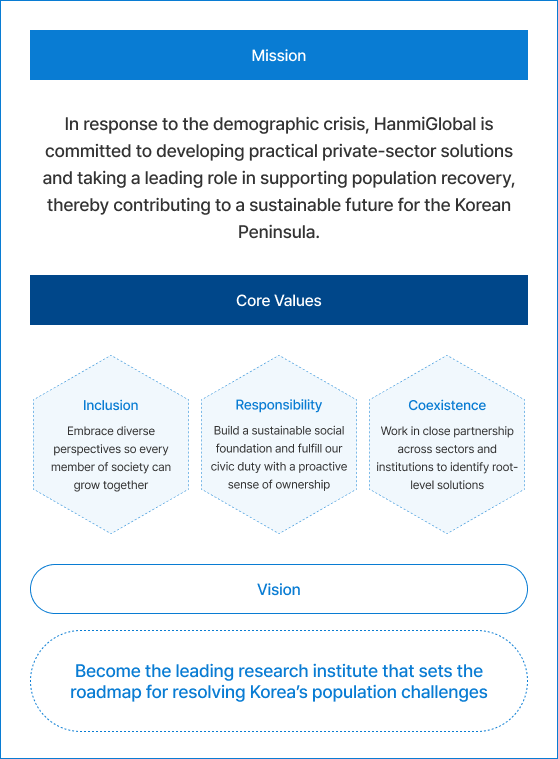
HanmiGlobal is taking proactive steps to address shifting demographics and to clarify the private sector’s role in building a sustainable society and economy. Low birth rates and population aging are no longer issues for governments alone; they affect companies and individual lives as well. By introducing life-cycle welfare programs for employees and establishing the Korea Peninsula Population Institute for Future (KPPIF), HanmiGlobal seeks both to improve the quality of life for its workforce and to help society adapt to demographic change.
In October 2022, recognizing that government measures alone have not stemmed the nation’s demographic decline, HanmiGlobal helped launch the private-sector-led Korea Peninsula Population Institute for Future (KPPIF). For years, the company had raised awareness of falling birth rates and population aging, hosting national strategy seminars and rallying stakeholders to action. The institute’s establishment marks the fruition of those efforts: former Prime Minister Chung Un-Chan serves as chair, while HanmiGlobal Chairman Kim Jong-Hoon is the founding representative; leaders from a broad range of disciplines also participate. Under the banner “Business Takes the Lead in Solving Population Issues,” KPPIF identifies core demographic challenges and pursues research, policy proposals, public engagement, campaigns, and education. The initiative forms part of HanmiGlobal’s human rights-oriented management, demonstrating the company’s commitment to social responsibility and to fostering sustainable social and economic development amid rapid population change.
Research Projects
Population Management
Evaluation of Family-friendly Management Best Practices
Corporate Support for Work-Life-Family Balance
Labor Market Changes and Response Strategies Reflecting the Characteristics of the Young Generation
Global Population Crisis and Government and Corporate Responses: Case Studies of Sweden and France
Comparative Analysis of Policies in Response to Regional Extinction and Outcomes in Korea and Japan
Analysis of Policy Effectiveness Based on Regional Demographic Characteristics
Institutions & Policy
Evaluation of Population-related Policy Pledges by Candidates in the 2026 Local Elections
Strategies to Expand Housing Supply for Young People and Newlyweds
Policies for Attracting Foreign Workers and Utilizing Human Resources in Response to Demographic Changes
Population Informatization
2026 Population Report
Survey on Young People’s Perceptions of Marriage and Childbirth
Basic Research on Population Education for Young People and the Development of Population Perception Indicators
Promotion of Hanmi Population Research Institute GPT and Initial Development of the Population Database and the Korean Peninsula Population Platform
Public Awareness and Campaign Initiatives
Seminars & Forums
Assessment of Regional Demographic Conditions and Enhancement of Policy Effectiveness
Five Population Vision Strategies for Responding to Demographic Transformation
Korea–Japan Private-Sector Cooperation for Joint Responses to Population Challenges
Korea–Japan Comparative Study on National Survival Strategies for Addressing Regional Depopulation
Reversing the Population Crisis Together with Migrant Workers
“Population Crisis: Finding Solutions Together” National Population Forum
Campaigns
Youth Population Supporters Program
2026 Local Election Population Manifesto Campaign
Campaign to Establish Korea Population Week
Public Outreach
Special Series on the Company’s YouTube Channel
Collaborative Platform Programs Aimed at Youth Audiences
Diversification of Target-specific Content and Expanded Use of Social-media Channels
Risk Management
HanmiGlobal operates a human rights due diligence process based on the UN Guiding Principles on Business and Human Rights (UNGPs) to proactively prevent potential human rights violations across its business activities and effectively manage related risks. Human rights risks are identified and assessed annually, with improvement plans established and mitigation measures implemented based on the assessment results. The implementation and effectiveness of these corrective measures are regularly monitored, and key findings are reported to the ESG Committee and incorporated into future action plans.
Human Rights Due Diligence Process
01
Risk Identification and Assessment
Once a year, HanmiGlobal identifies potential and actual human rights risks by reviewing internal documents, gathering employee feedback, and analyzing grievance channels. The identified risks are assessed based on their potential impact and likelihood of occurrence.
02
Risk Mitigation and Corrective Actions
Based on the assessment results, the company establishes improvement plans for key human rights risks and implements mitigation measures, including enhancing work procedures, providing relevant training, and strengthening preventive controls.
03
Monitoring and Performance Review
The implementation and effectiveness of corrective actions are reviewed on a regular basis. Key findings are reported to the ESG Committee and incorporated into future action plans.
Key Human Rights Issues and Management Measures
HanmiGlobal operates a human rights due diligence process based on the UN Guiding Principles on Business and Human Rights (UNGPs) to proactively prevent potential human rights violations across its business activities and effectively manage related risks. Human rights risks are identified and assessed annually, with improvement plans established and mitigation measures implemented based on the assessment results. The implementation and effectiveness of these corrective measures are regularly monitored, and key findings are reported to the ESG Committee and incorporated into future action plans.
Unfair practices in the supply chain leading to vendor lawsuits, rising Voice-of-Employee (VoE) complaints from specialized staff, and late-payment cases that violate the Sub-contracting Act
Low
Minor
Operate the Cyber Whistle-Blower Hotline; respond to VoE through the responsible HR team; ensure staff understand relevant laws
Prevention of unethical behavior
Employees Suppliers/Sub contractors
Cases of fraud, sexual harassment, workplace bullying, or personal data leaks
Moderate
Major
Enforce the “One-Strike-Out” rule on sexual harassment and run regular training to raise awareness; strengthen training that improves decision-making transparency for senior personnel
Industrial safety assurance
Employees Clients Suppliers/Sub contractors
Inadequate emergency response, personal injuries, or serious accidents that trigger regulatory sanctions
Moderate
Major
Strengthen comprehensive countermeasures to prevent serious accidents; enhance the safety-management system and related training
Non discrimination
Employees Job applicants
Violations of the Act on the Protection of Fixed-term and Part-time Workers, the Fair Hiring Procedure Act, or the Personal Information Protection Act
Low
Major
Monitor revisions to labor legislation; review statutes on non-regular workers and analyze unit-level use; manage system security and apply role-based access to personal data
Legal working conditions
Employees
Breaches of the Labor Standards Act, such as exceeding the 52-hour workweek or failing to pay the statutory minimum wage
Low
Moderate
Track changes in labor legislation and update internal rules accordingly
2025 Key Human Rights Management Risk and Management Results
Priority Risk
Risk of incidents involving sexual harassment and workplace bullying
Selection Criteria
Selected based on the previous year's performance analysis and the results of the annual human rights risk assessment
Management Activities
Preventive training, implementation of a zero-tolerance (“One Strike Out”) policy for sexual harassment, operation of grievance reporting channels, and implementation of victim protection and remediation procedures
Effectiveness Evaluation
Achieved 100% implementation of planned management measures and action items, with the effectiveness of the measures successfully verified
Future Plan
Continue preventive activities and ongoing monitoring to ensure that such incidents do not occur
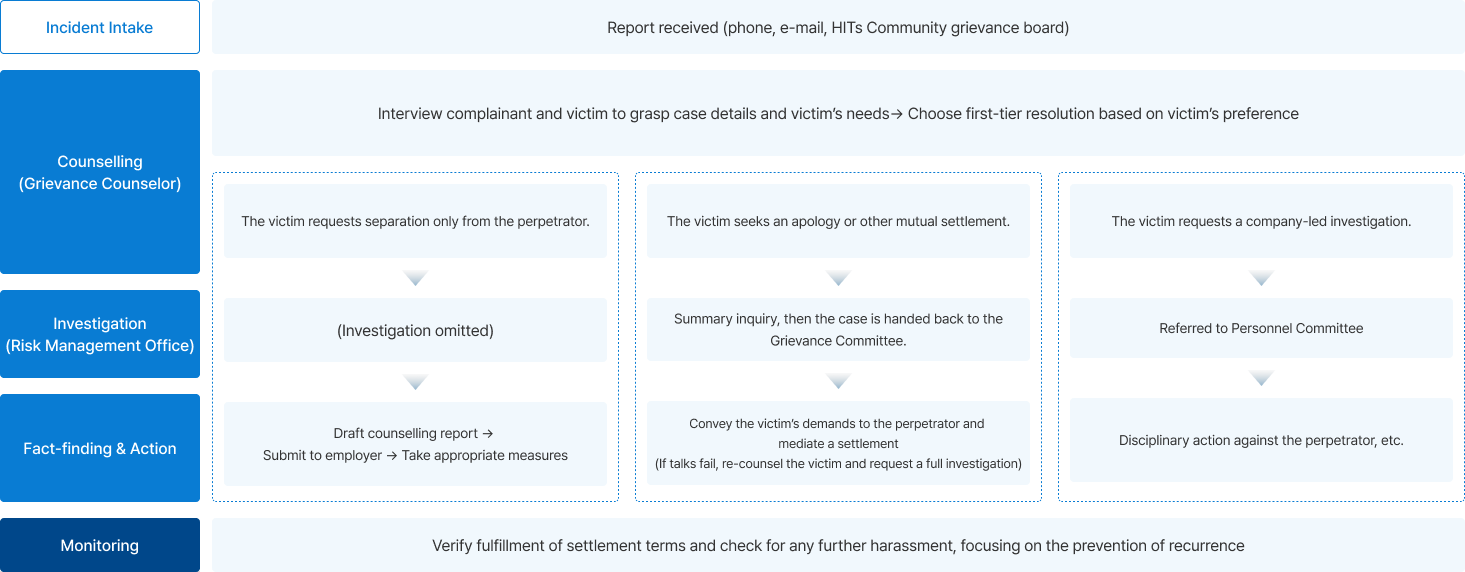
Prevention and Management Process for Workplace Sexual Harassment and Bullying
In particular, sexual harassment and workplace bullying were designated as the company's priority human rights management risk for 2025. Management efforts focus on prevention, reporting, investigation, victim protection, and measures to prevent recurrence. The company's response process is designed to support victims in returning to a healthy working environment. Counselors and investigators protect the identities of all parties involved, while cases are handled fairly through the Grievance Committee and the Risk Management Office.
Metrics & Targets
Mid- to Long-term Human Rights Management Goals and Performance
HanmiGlobal has established key management indicators to ensure that its human rights management policy is translated into meaningful improvement activities rather than remaining a statement of principles. The company has developed detailed KPIs focused on raising human rights awareness, assessing the level of its human rights-oriented organizational culture, ensuring the effectiveness of grievance handling procedures, and promoting workforce diversity. Performance is monitored annually against established targets. In 2025, HanmiGlobal achieved a 100% completion rate for employee human rights training, an HGTI human rights score of 81, and a 100% on-time resolution rate for grievance cases. However, the proportion of women in management positions and the proportion of foreign employees fell short of their respective targets. Accordingly, the company will continue implementing initiatives to strengthen workforce diversity. Going forward, HanmiGlobal will continue to prevent human rights risks and foster a workplace culture founded on respect by managing its performance against detailed human rights KPIs.
Category
Unit
2023 Targets / Performance
2024 Targets / Performance
2025 Targets / Performance
2026 Target
2027 Target
2028 Target
Employee Human Rights Training Completion Rate
%
100 / 100 ✓
100 / 100 ✓
100 / 100 ✓
100
100
100
HGTI Human Rights Assessment Score
Points
-
-
80 / 81 ✓
82
84
85
Grievance Resolution Rate within the Required Timeframe