Search within page
0/0
Climate Change Response
HanmiGlobal follows the recommendations of the TCFD (Task Force on Climate-related Financial Disclosures) to conduct climate scenario analysis and publicly disclose its climate change response and implementation progress in line with its information disclosure framework.
- Governance
-
Addressing climate-related risks and opportunities Strengthening governance and response organizations
- Strategy
-
Strengthening responses through climate-related risk and opportunity impact analysis and strategy development
- Risk Management
-
Systematizing risk assessment and risk management processes
- Metrics & Targets
-
Building a performance management framework for climate-related risks and opportunities
Governance
Managing and Overseeing Climate-Related Risks and Opportunities at the Board Level
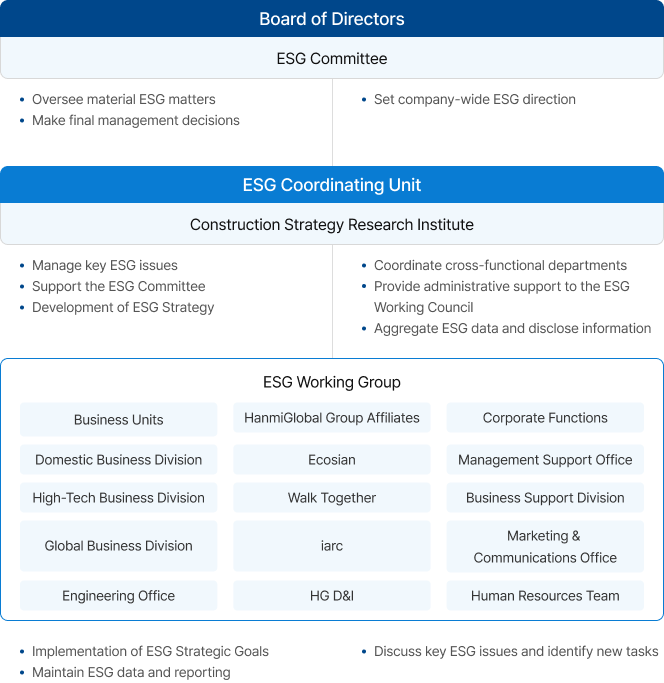
Since 2021, HanmiGlobal has operated an ESG Committee under its Board of Directors to oversee and supervise climate change response through the company's highest decision-making body. In accordance with the ESG Committee Charter, the committee is chaired by an outside director, and outside directors constitute a majority of its members, thereby strengthening the independence of the Board's oversight of climate change-related matters. The ESG Committee convenes at least three times a year to review key ESG agenda items, including ESG implementation plans, progress monitoring, the identification of material issues, approval of the Sustainability Report, and reporting of ESG assessment results, including matters related to climate change response. Matters discussed and resolved by the ESG Committee are reported to the Board of Directors, enabling Board-level oversight of the company's climate change response strategy and mid- to long-term ESG initiatives, including its 2030 greenhouse gas emissions reduction target.
Management’s Role in Evaluating and Managing Climate-Related Risks and Opportunities
Since 2021, the CEO has been appointed as a member of the ESG Committee, leading the implementation of climate strategies across the company. The CEO and senior executives share climate policy trends, corporate strategies from domestic and international companies, and the company's environmental innovation initiatives through the "CEO's Corner," strengthening communication both internally and externally. The Construction Strategy Research Institute, as the lead organization, collaborates closely with affiliated business units and subsidiaries in the ESG Working Group to drive climate change strategies forward.
Strategy
Impact of Climate-Related Risks and Opportunities on the Organization’s Business, Strategy, and Financial Plans
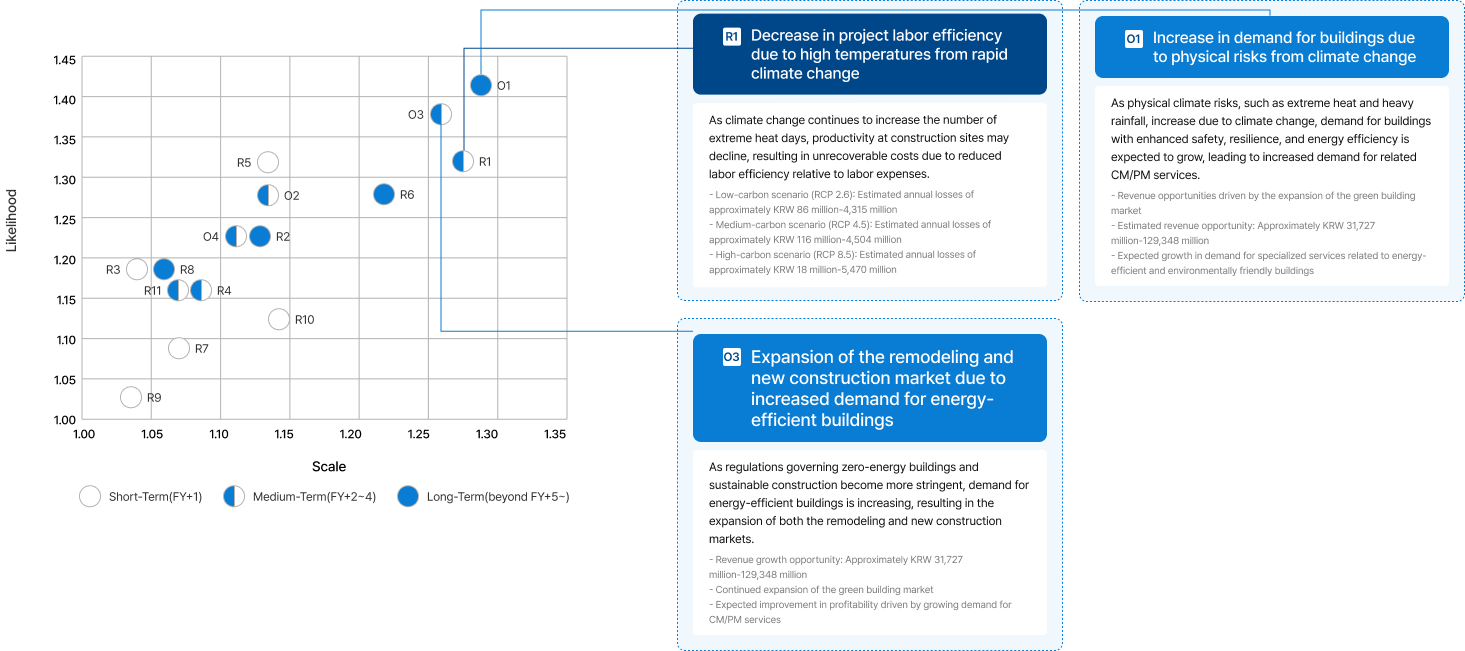
Based on its entire value chain, HanmiGlobal identified short-, medium-, and long-term climate-related risks and opportunities that could affect its business activities and established an issue pool. Through a materiality assessment, the company identified 15 key issues requiring priority action. Among these identified issues, HanmiGlobal selected the following as the most significant factors with substantial financial impacts based on their likelihood of occurrence and potential magnitude of impact: Reduced workforce productivity on projects due to extreme heat resulting from rapid climate change (R1); Increased demand for buildings driven by rising physical risks associated with climate change and the growing need for sustainable infrastructure (O1); Expansion of the remodeling and new construction market driven by increasing demand for energy-efficient buildings (O3). For these key risks and opportunities, HanmiGlobal analyzed the financial impacts under various climate scenarios and established response strategies, including strengthening occupational safety and health training, improving site working conditions, responding to the growing green building market, and expanding R&D related to energy-efficient and environmentally friendly construction.
Climate-Related Risks and Opportunities Evaluation Matrix
Identification of Climate-related Risks and Opportunities, and Response Status and Plans
HanmiGlobal has assessed the impacts of identified climate-related risks and opportunities over the short, medium, and long term, and has established response measures and implementation plans for each. To address physical risks, the company is strengthening occupational safety and health training and improving on-site working conditions to mitigate the impacts of climate change, including extreme heat. To address transition risks, HanmiGlobal is implementing initiatives such as establishing a carbon neutrality roadmap and implementation strategy, improving energy efficiency at business sites, reviewing cost forecasting technologies, and expanding R&D investment in carbon neutrality-related technologies. In addition, HanmiGlobal addresses reputational risks through active communication with major investors and stakeholders, as well as transparent disclosure of its strategies and performance in its Sustainability Report. To capitalize on climate-related opportunities, the company is expanding internal R&D investments in energy-efficient and environmentally friendly buildings and reviewing the application of carbon neutrality technologies in its projects. Through these initiatives, HanmiGlobal aims to respond to growing demand for sustainable and energy-efficient buildings while securing new business opportunities arising from the expansion of the remodeling and new construction markets and increasing demand for specialized green building services.
Risk Management
Climate-Related Risk Management Process
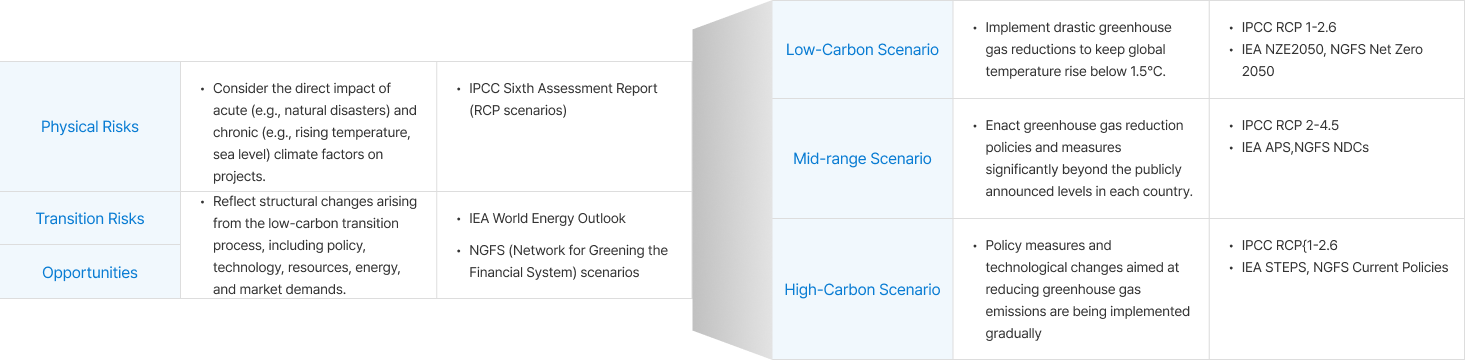
HanmiGlobal identifies physical and transition risks and opportunities arising from climate change by analyzing the potential changes in the business environment. Using the IPCC RCP scenarios and the IEA and NGFS base scenarios, we assess the impacts of low-carbon, intermediate, and high-carbon scenarios. This allows us to evaluate potential policies, technology, market changes, and the likelihood of natural disasters, helping us formulate a response strategy. We also set sector-specific reduction targets and implementation plans to strengthen the foundation for sustainable growth.
- Identification of Risks and Opportunities
-
Based on climate change scenarios, identify potential risks and opportunities across all ongoing projects and the entire value chain, both domestically and internationally.
- Materiality Assessment of Risks and Opportunities
-
Assess the impact of identified climate-related risks and opportunities on the business environment, using feedback from relevant departments and external experts to prioritize and evaluate materiality.
- Scenario-Based Risk Analysis
-
Analyze physical and transition risks and opportunities under various scenarios, including the 1.5°C target, to assess their potential impact on the business environment.
- Financial Impact Assessment and Response Strategy
-
Evaluate the financial impact of climate-related risks and opportunities and develop strategies and action plans to enhance resilience and manage related indicators.

Climate-Related Materiality-Assessment Process
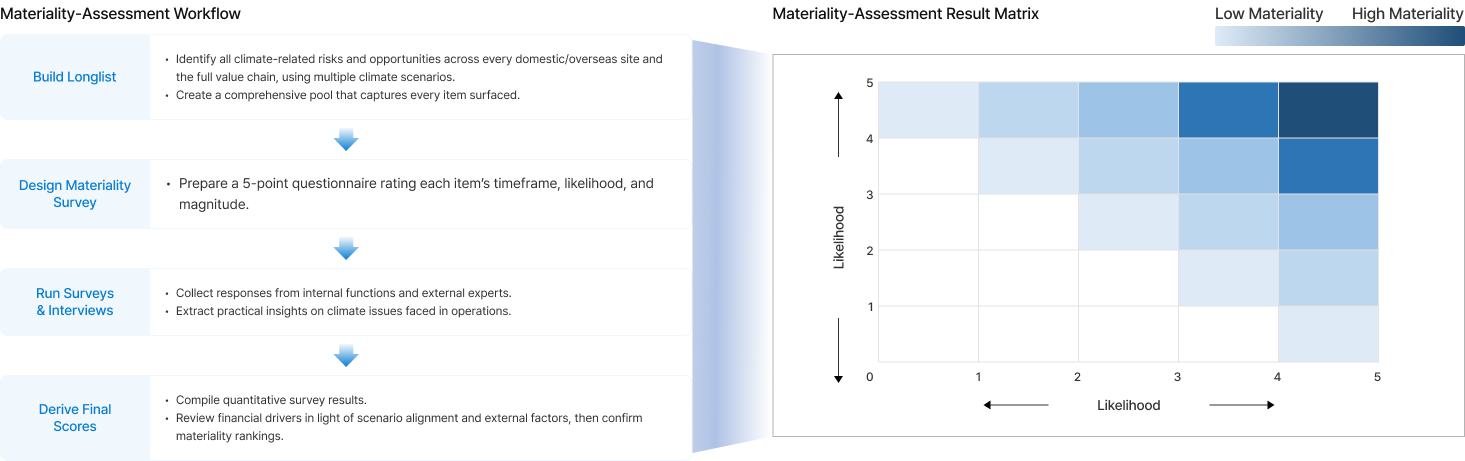
HanmiGlobal identifies climate risks and opportunities that could materially affect the business, quantifies their potential financial impact, and builds response plans. Guided by the TCFD recommendations, the company applies a step-by-step materiality procedure in which the relevant functions first surface transition/physical risks and opportunities, then are evaluated by internal and external experts to create the materiality pool. Each factor is scored quantitatively on its business impact, considering time horizon (Duration), impact size (Magnitude), and likelihood of occurrence (Likelihood). Stakeholder feedback from the responsible departments is incorporated to ensure the robustness and practical relevance of the results.
Climate Change Scenario Analysis
Process for Identifying, Assessing, and Managing Climate-Related Risks
HanmiGlobal operates an enterprise-wide risk-management (ERM) framework that covers identification, assessment, and response and post-response monitoring across every business area. During project development and investment, risks are managed systematically for both the front-end and operational phases so that counter-measures are optimized for each stage. When a potential climate-related risk is detected, the escalation path is: Dedicated Risk Unit → Risk Owner → C-Level. Under the company’s ISO 14001 environmental-management system, major climate-related risks are monitored according to documented procedures, and follow-up actions are executed by the relevant units.
Escalation Structure for Climate-Related Issues

ISO 14001 Certification

Indicators and Reduction Targets
Indicators Used to Evaluate Climate-Related Risks and Opportunities
- ※ Scope 3 Category 15 emissions for 2023 and 2024 have been restated following changes to the calculation methodology.
- 1 Direct emissions from natural-gas consumption at HQ plus fuel burned by company vehicles operating at HQ and project sites
- 2 Greenhouse gas emissions from electricity consumption at the headquarters office and the operation of electric vehicles at project sites.
- 3 Emission intensity is calculated by dividing total GHG emissions by revenue reported in the separate (non-consolidated) statement of profit and loss.
- 1 "Total energy use” combines HQ natural gas and electricity with fuel consumed by HQ and site vehicles; the latter is estimated from fuel invoices and mileage records for the company fleet.
- 2 Energy-use intensity is total energy use divided by revenue in the separate (non-consolidated) statement of profit and loss.
Climate Targets Used to Manage Risks, Opportunities, and Performance
HanmiGlobal has incorporated ESG management into its 2027 Vision and established mid- to long-term climate change response goals, strategic initiatives, KPIs, and organization-specific action plans. Using 2022 as the base year, the company has set a target to reduce its Scope 1 and Scope 2 greenhouse gas emissions (on a separate financial reporting basis) by 2.5% annually, achieving a total reduction of 20% by 2030. Given the nature of HanmiGlobal's business, which primarily provides professional engineering and project management services, business growth and the resulting expansion of its workforce may lead to increased transportation-related energy consumption and higher Scope 1 and Scope 2 greenhouse gas emissions. Accordingly, in addition to its absolute Scope 1 and Scope 2 emissions reduction targets, HanmiGlobal has established greenhouse gas emissions intensity targets to systematically monitor and manage its performance. Furthermore, the company aims to achieve Net Zero carbon emissions by 2050, focusing on its Scope 1 and Scope 2 emissions on a separate reporting basis.