Search within page
0/0
Eco service expansion
HanmiGlobal recognizes the significance of the building sector, which accounts for 32.8% of Korea’s 2050 carbon-neutral target, and is committed to helping achieve that goal through technology development and advanced engineering solutions. Effective carbon reduction in Korean construction requires a clear understanding of where and how emissions occur across the entire project life-cycle, from financing, planning, and design to material production and transport, construction, and operations. Studies show that embodied carbon in building materials and operational carbon during the use phase together represent more than 80 percent of a project’s life-cycle emissions. Responding to this challenge, HanmiGlobal is taking the lead in low-carbon design using timber, in top-tier building-energy management systems, and in engineering for offshore-wind facilities.
From early planning and design through construction and operations, the Company will deliver technology-based solutions that combine specialist engineering, green technologies tailored to each project, and disciplined project management, thereby benefitting clients and local communities alike. Dedicated operating teams, staffed by experts in each discipline, will apply differentiated technical capabilities to enhance sustainability throughout the full life-cycle of every project. Over the past two decades, HanmiGlobal has continually upgraded the functionality of its consulting, system, and solution offerings, with the ultimate aim of becoming a total green-solution provider that lets clients access all environment, energy, and climate-change services through a single integrated platform.
Carbon-Reduction Engineering
Whole-Building Carbon Management via Life-Cycle Assessment (LCA)
Current Korean building policies focus mainly on cutting operational energy use. Green Building Certification, for example, addresses resource-efficient materials, eco-label products, and low-carbon materials. Still, it does not yet account for the carbon released during material production or at the end-of-life stage. HG PRECON team, therefore, adds carbon-reduction design control and whole-building LCA to the usual management set of design review, cost control, scheduling, and quality assurance. The team is building a standardized system that sets criteria for low-emission materials in the production phase and measures environmental impacts at demolition. This approach moves beyond energy-saving regulations to deliver truly green construction by evaluating materials and use and end-of-life impacts across the entire building life cycle.
Key Management Items and Analysis Systems for Carbon-Reduction Engineering

Managing a building’s environmental impact must move beyond energy-use reduction to include sustainable material choices that cut emissions at the production stage. For that reason, life-cycle assessment of the entire building is essential.

Gaeunsan Village (Jongam-dong) Street Housing Renovation Project
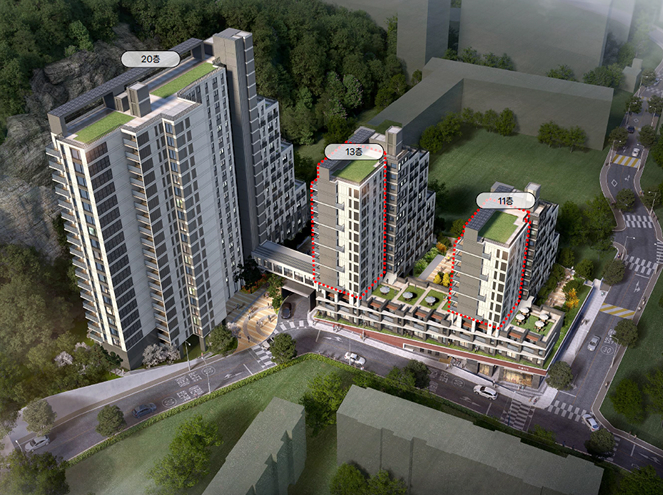
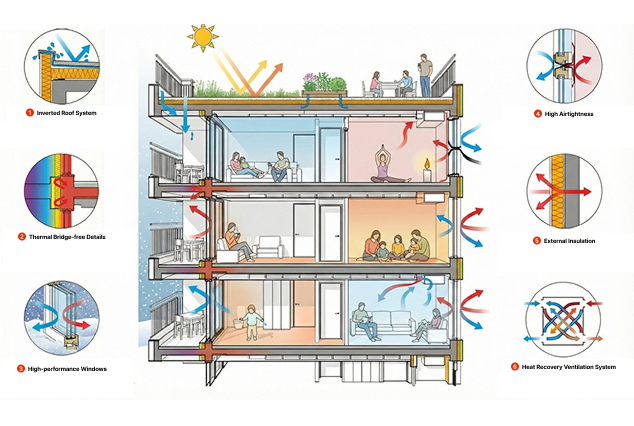
Gaeunsan Village Street Housing Renovation Project located in Seoul’s Jongam-dong, designed by Gansam Architects & Partners, constructed by Bomi Construction, and managed by HanmiGlobal as the project manager, is a representative low-carbon and eco-friendly residential project. With a total project area of 23,404 ㎡, the development consists of 130 residential units in a building ranging from three basement levels to 20 above-ground floors. The project features the housing association’s own apartment brand, “Commons.” The building incorporates a passive house design through external insulation, focusing on significantly improving insulation and airtightness performance while reducing carbon dioxide emissions. In particular, the project is the first in Korea to apply wooden structures and OSC (Off-site Construction) methods to selected units (18 households). Based on this innovative approach, the project aims to become the first apartment development in Korea to obtain both Passive Building Certification and Carbon Neutral Building Certification in the future.
Using Renewable Resources such as Solar Power and Geothermal Energy
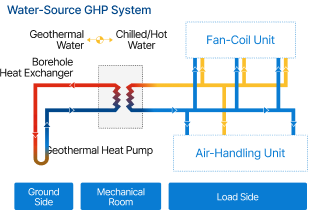
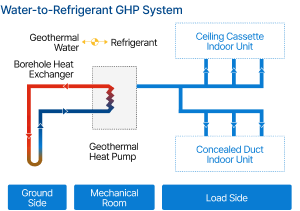
To achieve carbon-neutral goals, it is essential to reduce building energy consumption and draw on renewable sources. Efficient use of natural energy, such as solar photovoltaic (PV) arrays and geothermal heat-pump (GHP) systems, cuts operational carbon while improving overall energy performance. In the long run, these technologies lower utility costs and deliver environmental benefits, raising a building’s sustainability profile and accelerating the transition to a net-zero society.
Gak Sejong Data Center Project
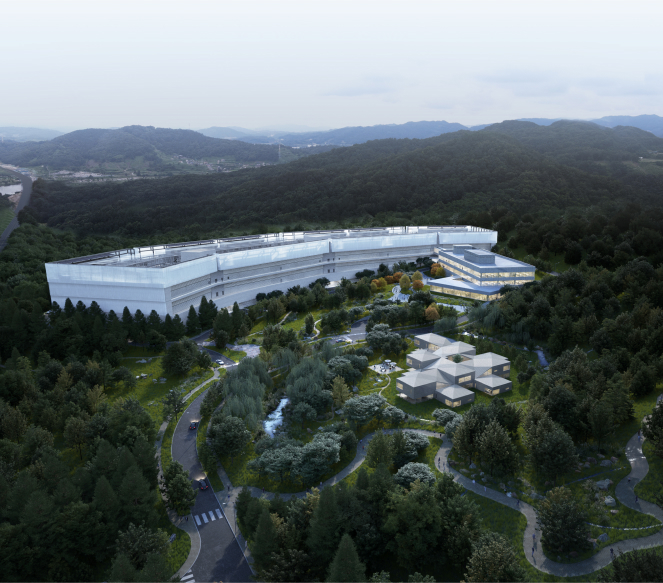
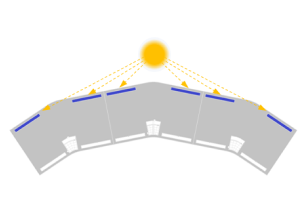
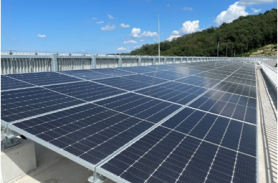
Gak Sejong, NAVER’s newest hyperscale data center, combines state-of-the-art technology with nature-friendly design to promote a sustainable future. By harnessing rooftop solar PV and geothermal heat-pump technology, the campus prioritizes lowering electricity demand and the related CO₂ emissions. The facility occupies 293,963 m²—roughly 41 soccer fields—and is six times larger than the company’s first data center (Gak Chuncheon). Solar PV panels installed on the server-hall roof generate 184 MWh of electricity per year, while geothermal heat pumps deliver efficient heating and cooling, saving 13,363 MWh annually. Thanks to sustainable land use, energy and air-quality measures, indoor-environmental quality, and six other evaluation categories, HanmiGlobal secured LEED Platinum certification for Gak Sejong.
Hana Dream Town Group Headquarters Project
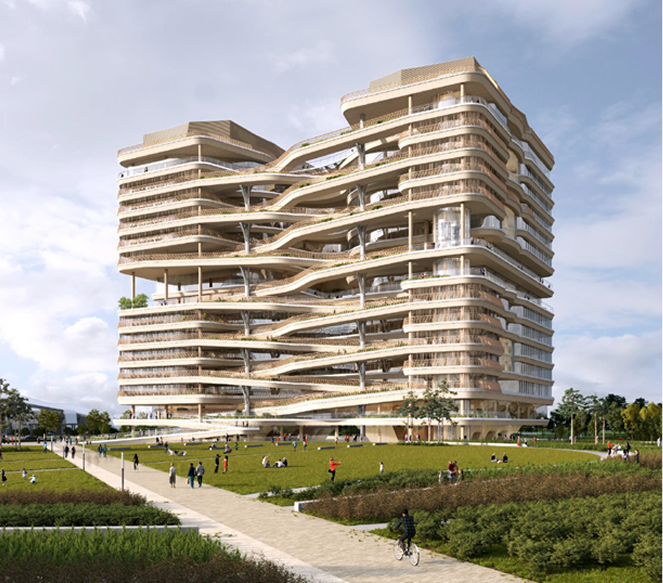
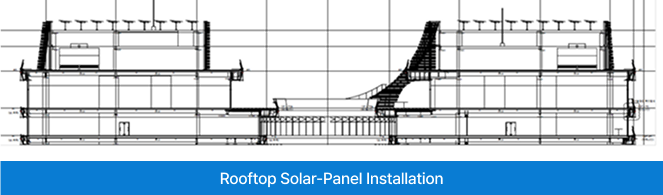
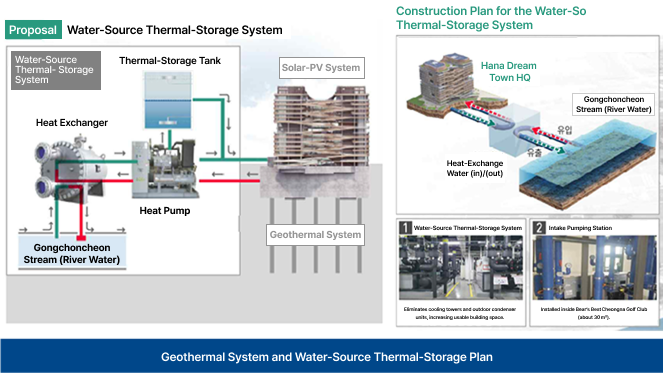
Designed by NBBJ, Gansam, and Kunwon and managed by HanmiGlobal, the Hana Dream Town Group HQ is a flagship green project. The 128,474 m² building will serve as Hana Bank’s new headquarters and prioritizes reducing electricity use and CO₂ emissions by integrating rooftop solar PV and geothermal energy. The roof carries 1,236 m² of solar panels, and eight closed-loop geothermal systems are being installed. At the construction stage, the project has already secured Korea Green Building preliminary certification, Grade 1 (Excellent).
Smart Green Solution
GHG and Energy Management
In the building sector, systems that monitor and control energy use and associated greenhouse-gas emissions during operations are essential to achieving carbon neutrality. Ecosian, a HanmiGlobal subsidiary, pursues the vision of becoming “the world’s top expert group leading knowledge industries in the environment and energy fields” and is already Korea’s No. 1 firm for environmental consulting and energy solutions, with unmatched credentials and staff expertise. By combining HanmiGlobal’s construction-management capabilities with Ecosian’s know-how in energy efficiency and environmental consulting, the two companies generate synergies in green buildings, construction IT, and renewable-energy projects. Pre-occupancy energy assessments and optimization of indoor environmental and energy performance reduce waste, while advanced ICT-linked systems cut electricity and fuel consumption, delivering low-carbon, green buildings. Ecosian filed and registered four technology patents in 2022 and one in 2023, undertook seventeen government-funded R&D projects during the same period, and in March 2023 earned “Good Software” quality certification from the Telecommunications Technology Association of Korea for its ES-BEMS building-energy-management platform. In 2024, the company began researching an AI-based autonomous space-control technology that maximizes energy efficiency while maintaining occupant comfort in each zone of a building. Working in close partnership, HanmiGlobal and Ecosian integrate this advanced energy-management technology with their growing big-data resources to deliver comprehensive consulting on environmental issues.
Components of the Energy & GHGs Management System


Eco-Friendly Building Solutions
As a participating member of the U.S. Green Building Council (USGBC)*, HanmiGlobal offers full-scope solutions for LEED* certification, Korean green-building ratings, and building-energy optimization based on advanced energy-simulation and optimization technologies. The company has delivered numerous projects that integrate building-energy-management systems (a prerequisite for both LEED certification and Zero-Energy Buildings) and operational-phase energy consulting, giving it unmatched technical depth and field experience. From the earliest planning stage, HanmiGlobal sets out an energy-reduction roadmap, provides technical reviews and design guidelines, and then supervises eco-friendly construction to ensure the original sustainability intent is achieved.
- ※ USGBC (U.S. Green Building Council): A nonprofit organization that promotes sustainable design, construction, and operations, and that develops and certifies the LEED Green Building Rating System
- ※ LEED (Leadership in Energy and Environmental Design): An internationally recognized green-building certification program

-
KT&G Sejong Printing Plant
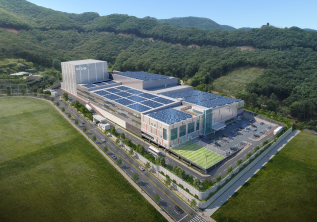
LEED v4.BD+C,NC [GOLD]An eco-friendly manufacturing facility incorporating water-saving and energy-efficiency measures, including rainwater and domestic water reuse systems, water-saving equipment, solar power facilities, and efficiency improvements for major systems such as chillers and air handling units. These initiatives contribute to reducing water consumption and improving energy efficiency.
-
Logisco Ansan
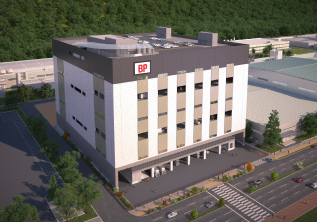
LEED v4.1 EB [Platinum]Following its LEED BD+C: Core and Shell Silver Certification, Logisco Ansan achieved LEED v4.1 O+M Platinum Certification during operational-stage recertification. This project represents an advancement in the operational performance and management system of a logistics center.
-
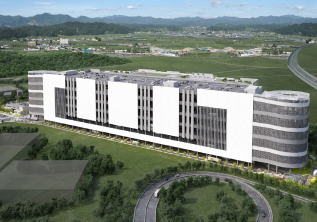
Goyang Logistics Park
LEED v4.1 EB [GOLD]This logistics facility achieved LEED Gold Certification during both the design/construction and operational phases by incorporating various eco-friendly elements, including water-saving fixtures, high-efficiency LED lighting, heat recovery ventilation systems, Low-E windows, recycling storage and collection systems, CFC-free systems, bicycle storage facilities, and carpool spaces.
-
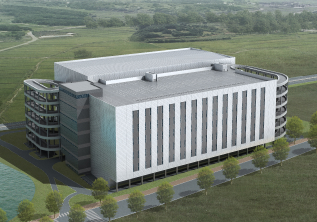
Pyeongtaek Kurly Logistics Center
LEED v4.BD+C,NC [GOLD]As a multi-temperature logistics center capable of operating ambient, controlled-temperature, refrigerated, and frozen storage facilities, this project was recognized for its eco-friendly performance through the optimization of energy efficiency and management systems during the operation of a large-scale logistics facility.
ESG Level-Up Solution
In response to the Paris Agreement and the growing global demand for ESG management, companies are striving to transition to low-carbon operations and enhance sustainability across their entire value chains. Ecosian, a HanmiGlobal subsidiary specializing in environmental and energy consulting, offers a comprehensive “ESG Level-Up Solution” that boosts international green competitiveness and corporate sustainability. The solution supports every step of the journey, from initial sustainability diagnostics and strategy formulation to execution and performance monitoring. It delivers practical net-zero pathways by building supply-chain greenhouse-gas inventories and conducting product life-cycle assessments, and it reduces energy use and cost through energy-management systems and renewable-energy feasibility studies. In addition, the solution enables integrated compliance with environmental regulations by managing chemicals and pollutants, establishing water-resource systems, and implementing environmental-health-safety management frameworks. Finally, it opens new business opportunities in the green sector by identifying waste-to-resource ventures and creating resource-circulation networks.

We support sustainable growth.
- Formulate a sustainability management strategy
- Respond to global initiatives and disclosure frameworks
- Establish an integrated ESG governance framework
- Implement an Integrated ESG Management System (ES-ESG)

We deliver practical net-zero solutions.
- Build a Scope 3 GHG inventory
- Identify and register GHG-reduction projects
- Analyze green supply chains and product LCAs
- Deploy an enterprise GHG management system (ES-ETS)

We cut energy use and cost.
- Diagnose energy-management systems
- Optimize energy efficiency and track performance
- Assess the feasibility of renewable-energy adoption (RE 100)
- Install an advanced energy-management system (ES-xEMS)

We enable integrated compliance with environmental regulations.
- Manage chemicals and pollutants
- Establish water-resource management systems
- Navigate integrated environmental permitting
- Build an environment, health & safety management system (ESEHS)

We unlock new business through resource circularity.
- Enhance circularity across the full life cycle
- Create resource-circulation networks
- Identify and plan new businesses that upcycle waste resources
- Build an industrial symbiosis platform (ES-RMS)
Renewable-Energy Environmental Plants
Renewable-Energy Facility Construction Technology
HanmiGlobal has participated in diverse projects that advance the green transition of urban, spatial, and lifestyle energy infrastructure and expand low-carbon, distributed energy. Over the past decade, the company has built a strong track record in solar- and wind-energy projects and now possesses unrivaled technical capabilities in renewable-energy construction. Drawing on experience with large-scale domestic and overseas environmental plants, onshore and offshore wind farms, and solar-power facilities, HanmiGlobal is preparing to secure next-generation expertise in floating offshore wind power construction.
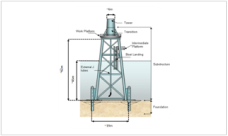
Jeonnam Offshore Wind Power Project
The Jeonnam Offshore Wind Power Project has a total generation capacity of 96 MW (10 turbines of 9.6 MW each) and is Korea’s first monopile-type offshore wind farm to begin commercial operation in 2024. The project was developed by Jeonnam Offshore Wind Power (JOWP), a joint venture established by SK E&S and Denmark’s Copenhagen Infrastructure Partners (CIP). HanmiGlobal provided Project Management services to the project owner.
Hallim Offshore Wind Power Project
The Hallim Offshore Wind Power Project is a 100 MW-class offshore wind farm that began commercial operation in 2024. Located offshore of Suwon-ri, Hallim-eup, Jeju City, the project represents an investment of approximately KRW 540 billion and contributes significantly to achieving the national greenhouse gas reduction target for 2030, the 2050 Carbon Neutrality goal, and Jeju City’s Carbon Free Island 2030 initiative. HanmiGlobal formed a consortium with Pondera, a Netherlands-based offshore wind power consulting company, to provide technical support for renewable energy development projects by combining HanmiGlobal’s expertise in onshore wind power with Europe’s advanced offshore wind technologies.
Pungbaek (Gunwi) Wind Power Project
The Pungbaek Wind Power Project is a large-scale onshore wind power project located in Samguk Yusa-myeon, Gunwi-gun, Daegu, which commenced commercial operation in 2025. A total of 71 transmission towers were installed to establish a 26.11 km transmission line. The wind farm is equipped with 15 wind turbines, each with a capacity of 5 MW, and is expected to reduce approximately 70,000 tons of carbon dioxide emissions annually. For this project, HanmiGlobal provided Project Management services to the project owner.
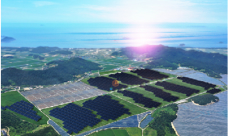
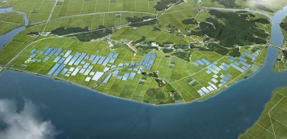
Dangjin Chorak-Dori Solar Power Project on Salt-Damaged Land
This large-scale clean-energy project will build a 160 MW photovoltaic plant on under-utilized reclaimed land whose agricultural productivity has been reduced by salt damage in Chorak-dori, Seokmun-myeon, Dangjin City, Chungcheongnam-do. Implemented in two phases—110 MW in Phase 1 and 50 MW in Phase 2—the development covers about 5.1 million m² (roughly 700 soccer fields) and is regarded as one of the largest solar projects in Korea.
Metrics & Targets
Mid- to Long-term Eco-friendly Service Goals and Performance
HanmiGlobal is expanding its eco-friendly service portfolio to realize sustainable construction and process innovation. Through the expansion of Smart Green Solutions, the company supports customers in improving building energy management and operational efficiency. In addition, HanmiGlobal is expanding its participation in renewable energy projects, contributing to low-carbon transition and the expansion of sustainable infrastructure. As part of its mid- to long-term goals, HanmiGlobal established targets of achieving 1,000 cumulative Smart Green Solution customers by 2025 and 5,000 MW of cumulative capacity from renewable energy participation projects by 2025. As of 2025, the cumulative number of Smart Green Solution customers reached 875 companies, indicating the need for continued expansion to achieve the target. Meanwhile, the cumulative capacity of renewable energy participation projects reached 5,083 MW, successfully achieving the mid- to long-term target. Going forward, HanmiGlobal will continue to expand its eco-friendly solutions and participation in renewable energy projects to support customers in improving environmental performance and contribute to the sustainable transformation of the construction industry.