0/0
Sustainability
CEO Message
Relentless innovation for authentic ESG management

Dear valued stakeholders,
Thank you for your continued interest and support over the past year.
Despite the volatility caused by intensifying U.S.–China tensions and the protracted war in Ukraine, all HanmiGlobal employees worked together in 2024 to achieve the highest performance in our history, exceeding every corporate target.
Through HG PRECON and an aggressive shift to digital, AI-powered ways of working (AX), we are differentiating our services and laying solid groundwork for future growth.
From the day the company was founded, HanmiGlobal has put stakeholders at the center of its mission and core values, delivering real contributions to clients, employees, shareholders, and society.
Guided by our 2027 Vision, announced in August 2022, we are upgrading our management base so that every team member can thrive in a happier workplace.
As part of our “Happiness Management” strategy, employees voluntarily carry out community service through the Walk Together Foundation, turning ad hoc volunteerism into a systematic, long-term program that creates social value.
Working with our leading green consulting affiliate Ecosian, we are integrating carbon-neutral and energy-saving solutions into PM services for buildings and are continuously developing new ESG-driven businesses in renewable energy, environmental infrastructure, and senior housing.
We also use AI-based data analytics and digital tools to measure ESG performance quantitatively and to improve our ability to predict and respond to safety, quality, and environmental risks.
The AI transition is becoming a critical springboard for executing our sustainability strategy. To prevent serious industrial accidents, we operate a CEO level Safety & Health Council and implement a structured safety management system that sets and executes proactive tasks each year to raise our safety culture and mitigate high-risk activities.
HanmiGlobal will practice genuine ESG management and, through ceaseless innovation and progress, build a sustainable future.
We respectfully ask for your warm interest and ongoing support in 2025 and beyond.
Thank you.
Kim Jong-hoon
Chairman, HanmiGlobal

ESG Strategy
HanmiGlobal has set its ESG goals and strategic tasks by analyzing its mission, core values, and material ESG issues. Based on these pillars, the company establishes mid to long-term KPI targets and corresponding action items. ESG maturity is periodically assessed, improvement plans are derived, and company-wide working councils – joined by all affiliates – drive the execution of ESG initiatives.
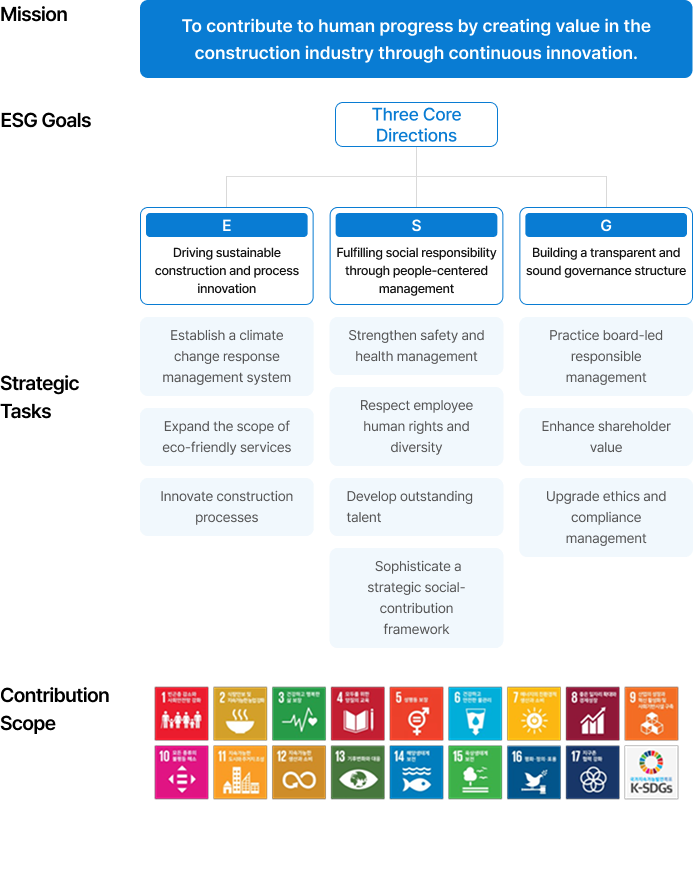

ESG Long-Term Goals
| ESG Objectives | Strategic Tasks | Key KPIs | 2024 Performance | Long-Term Goals | SDGs Alignment |
|---|---|---|---|---|---|
|
Driving sustainable construction and process innovation
|
Establish a climate change response management system | GHG (Scope 1, 2) emissions | 304.1tCO₂eq | 2030: 220tCO₂eq |  |
| GHG (Scope 1, 2) emissions intensity | 174.4tCO₂eq / KRW 100bn | 2030: 126tCO₂eq / KRW 100bn | |||
| Environmental management system (ISO14001) certification | Certification maintained | Certification maintained | |||
| Expand the scope of eco-friendly services | Number of customers adopting Smart Green Solutions | 355 clients | 1,000 clients by 2025 |  |
|
| Renewable energy participation capacity | 4,686MW | 5,000MW by 2025 | |||
| Innovate construction processes | Share of pre-construction revenue in total revenue | 23.8% | 30% by 2027 |  |
|
| Number of construction sites implementing digital tools | 49 sites | 80 sites by 2027 | |||
|
Fulfilling social responsibility through people-centered management
|
Strengthen safety and health management | Number of violations under the Serious Accident Punishment Act | 0 violations | 0 violations |  |
| Achievement rate of safety personnel training | 90% | 85% | |||
| Number of recordable incidents per site | 0.42 incidents | 0.75 incidents | |||
| Safety and health management system (ISO45001) certification | Certification maintained | Certification maintained |  |
||
| Respect employee human rights and diversity | Percentage of women in managerial positions | 6.5% | 8% by 2027 | ||
| Percentage of foreign employees | 30.1% | 35% by 2027 | |||
| Develop outstanding talent | Percentage of employees with professional-engineer certifications | 19.3% | 18% by 2027 |  |
|
| Number of GPMU training courses | 422 courses | 500 courses by 2027 | |||
| Number of NCLA graduates (university education) | 1,110 graduates | 1,500 graduates by 2027 | |||
| Sophisticate a strategic social contribution framework | Volunteer hours per employee | 27 hours | 20 hours by 2027 |  |
|
|
Building a transparent and sound governance structure
|
Practice board-led responsible management | Compliance rate with key governance indicators | 53.3% | 70% by 2027 |  |
| Enhance shareholder value | |||||
| Upgrade ethics and compliance management |
2024 ESG Highlights
Double Materiality Assessment
Methodology
HanmiGlobal conducts a materiality assessment every year to identify the issues that require the most urgent attention in order to advance sustainable management.
For 2024, we identified 25 issues across the environment, social, and governance pillars, evaluating each in terms of stakeholder perception and potential impact. The assessment results guide our response activities and the performance we disclose.
-
STEP 1
Build the ESG Issue Pool
We examined internal conditions and the external landscape—media coverage, peer benchmarks, and international standards—to create an initial issue list.
Mapping that list to global ESG frameworks and rating criteria yielded a pool of 25 issues.-
E
- Advanced environmental management system
- Energy efficiency improvement
- Climate scenario analysis
- Waste reduction & circularity
- Construction process & technology innovation
- Biodiversity protection
- Expanded GHG management
- Broader eco service offering
-
S
- Improved human rights management
- Employment & labor conditions
- Safety first culture expansion
- Community engagement & contribution
- Customer satisfaction management
- Information security
- Anti-discrimination & diversity
- Win-win growth with partners
- Talent development & support
-
G
- Board-led responsible management
- Everyday ethics
- Stronger shareholder rights
- Anti-corruption & compliance
- Shareholder returns
- Broader disclosure scope
- Enhanced audit regime
- Integrated risk management
-
-
STEP 2
Analyze Issues & Score Materiality
From the issue pool, we prioritized topics by analyzing both social/environmental impact and financial impact. HanmiGlobal applies a double materiality lens, evaluating not only how each issue affects society and the environment but also how it can influence the company’s financial performance.
Stakeholder input was incorporated throughout the process, producing an ESG issue set that balances impact materiality with financial materiality and will be embedded in business activities.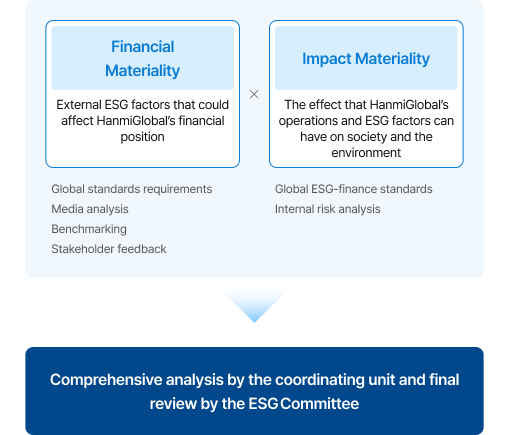
-
STEP 3
Identify Material Issues
The double materiality assessment identified 13 reportable ESG issues relevant to HanmiGlobal’s operations. After review and approval by the ESG Committee, the issues—together with related strategies, plans, actions, and performance—were disclosed transparently in this report. Among them, the three issues with the highest combined scores were designated Key Issues for top-tier management focus:
- KEY ISSUE 1. Expanding a safety-first culture
- KEY ISSUE 2. Innovating construction processes and technologies
- KEY ISSUE 3. Enhancing customer satisfaction management
Covering All 13 ESG Reporting Issues
HanmiGlobal reports its principal activities and response measures for all 13 material ESG issues under the environment, social, and governance pillars, presenting for each topic an integrated view of policies and targets, implementation framework, achievements in execution, and future direction, while providing stakeholders with detailed descriptions of issue-specific actions in the main text.

Assessment Results
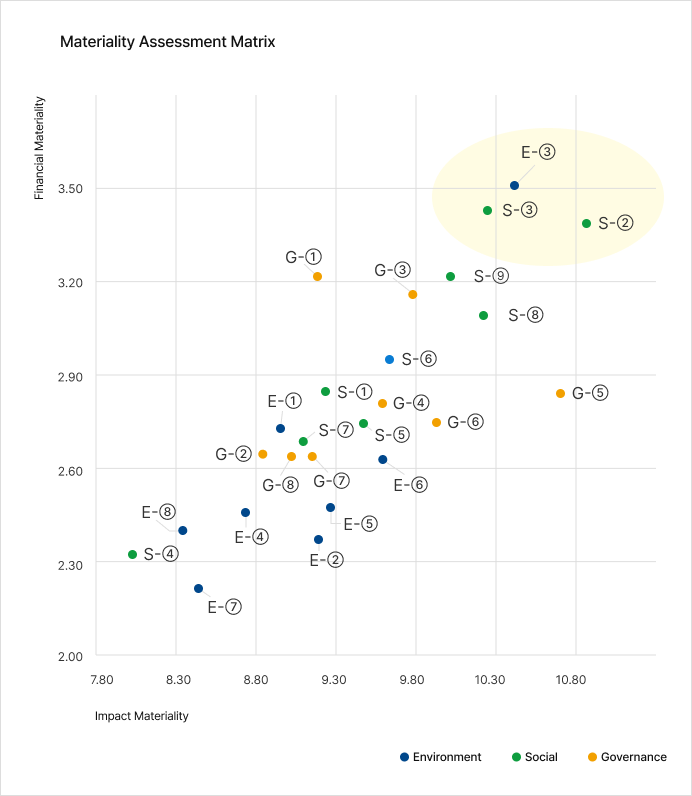
| ESG Issue Pool | Reporting Topic | |
|---|---|---|
| E-① | Advanced environmental management system | Environmental management |
| E-② | Climate scenario analysis | Climate change response |
| E-③ | Construction process & technology innovation ★ | Construction process and technology innovation |
| E-④ | Expanded GHG management | Climate change response |
| E-⑤ | Energy efficiency improvement | Environmental management |
| E-⑥ | Waste reduction & circularity | Environmental management |
| E-⑦ | Biodiversity protection | Environmental management |
| E-⑧ | Broader eco service offering | Eco service expansion |
| S-① | Improved human rights management | Human rights management |
| S-② | Safety first culture expansion ★ | Safety & health |
| S-③ | Customer satisfaction management ★ | Customer satisfaction |
| S-④ | Anti-discrimination & diversity | Human rights management |
| S-⑤ | Talent development & support | Talent development |
| S-⑥ | Employment & labor conditions | Human rights management |
| S-⑦ | Community engagement & contribution | Social contribution |
| S-⑧ | Information security | Information security |
| S-⑨ | Win-win growth with partners | Excluded issue |
| G-① | Board-led responsible management | Advanced governance |
| G-② | Stronger shareholder rights | Advanced governance |
| G-③ | Shareholder returns | Advanced governance |
| G-④ | Enhanced audit regime | Advanced governance |
| G-⑤ | Everyday ethics | Advanced governance |
| G-⑥ | Anti-corruption & compliance | Ethics & compliance |
| G-⑦ | Broader disclosure scope | Ethics & compliance |
| G-⑧ | Integrated risk management | Ethics & compliance |
Stakeholder Engagement
HanmiGlobal defines its primary stakeholders as shareholders and investors, employees, customers, partners and suppliers, local communities, and the government. Guided by clear stakeholder definitions and dedicated communication channels, the company continuously gathers feedback, identifies key concerns, and incorporates them into its management and decision-making processes.
Stakeholder Impact Analysis
HanmiGlobal strives to improve business performance and create social and environmental value across all its operations by clearly understanding stakeholder needs and integrating them into management strategies. Through the double materiality assessment conducted in 2024, the company has differentiated the financial impacts and social and environmental impacts of ESG issues and analyzed the influence of each issue on key stakeholders.